Introduction
Ants are one of the most common household pests, and it doesn’t take long for a few scouts on the kitchen counter to turn into a full trail marching across your floor. Ant activity tends to spike in warmer months, though it’s worth checking our seasonal pest guide if you’re noticing unusual activity outside of peak season. With so many products on shelves, this guide to the best ant killers of 2026 is designed to cut through the noise — baits, gels, sprays, granules, and natural remedies all work differently, and picking the wrong one can waste time and money without solving the problem.
This guide breaks down how each type of ant killer works, reviews ten of the most widely used products on the market, and explains how to match a product to your infestation. Whether you’re dealing with a few ants in the kitchen or a full colony in the yard, understanding what actually eliminates ants — rather than just killing the ones you see — is the key to lasting results.
Table of Contents
Why Choosing the Right Ant Killer Matters
Different Ant Species
Not all ants respond to the same products. Odorous house ants, carpenter ants, pavement ants, and fire ants have different food preferences, nesting habits, and vulnerabilities, so identifying the species with our ant identification guide helps narrow down the most effective treatment.
Colony Behavior
Ants operate as a colony, not as individuals. Killing the visible worker ants does little to solve the problem if the queen and the rest of the colony remain safe underground or inside a wall void. If you’re not certain what you’re seeing is even an ant colony, our pest identifier tool can help confirm before you treat.
Indoor vs. Outdoor Infestations
Indoor ant problems usually call for baits and gels placed along trails, while outdoor infestations, especially large colonies or mounds, often respond better to granules or perimeter treatments.
Queen Elimination
The most effective ant killers work slowly enough that foraging ants carry the product back to the nest and share it with the queen and larvae, ultimately collapsing the colony rather than just thinning out visible workers.
Long-Term Control
A single application rarely solves a persistent ant problem. Long-term control usually combines an effective product with sealing entry points and removing food sources that keep attracting new colonies — the same principles covered in our integrated pest management guide.
Types of Ant Killers
Understanding how each category works is the fastest way to narrow down the best ant killers for your specific ant problem, whether that’s a few scouts on the counter or an established outdoor colony.
Ant Baits
How They Work
Ant baits combine a food attractant with a slow-acting active ingredient. Worker ants carry the bait back to the colony, sharing it with other workers, larvae, and the queen.
Advantages
Baits target the entire colony rather than just visible ants, and many formulas are enclosed in child-resistant stations, making them a safer option around kids and pets.
Disadvantages
Baits take longer to show results, often one to two weeks, and moving or disturbing a bait station too early can interrupt the process before it reaches the colony.
Best Use Cases
Baits work well for persistent indoor trails and situations where full colony elimination, not just quick knockdown, is the goal. Fire ants, an invasive species tracked by the USDA’s invasive species research, often require granular baits specifically formulated for mound treatment rather than standard indoor baits.
Ant Gels
Indoor Applications
Gels are typically applied in thin lines or small dots near entry points, cracks, and along known ant trails, making them useful in kitchens, bathrooms, and other tight indoor spaces.
Slow-Acting Colony Elimination
Like baits, gels rely on a delayed-action ingredient that worker ants transport back to the colony, allowing the treatment to reach ants that never directly contact the application point.
Pros and Cons
Gels are precise and easy to apply in small spaces, but they can dry out or become less effective over time and typically need reapplication in active areas.
Ant Sprays
Instant Kill
Contact sprays kill ants on contact, making them useful for quickly clearing a visible trail or nest opening.
Residual Effects
Many sprays leave a residual barrier that continues killing ants that cross the treated surface for days or weeks after application.
Indoor and Outdoor Use
Sprays are versatile and can be used along baseboards, doorframes, and outdoor foundations, though they generally don’t eliminate the colony itself the way baits and gels do.
Ant Granules
Yard Protection
Granular ant killers are scattered across lawns, garden beds, or around the home’s perimeter to create a treated zone that discourages colonies from establishing nearby.
Outdoor Colonies
Granules are especially effective against outdoor mound-building species like fire ants, since they can be applied directly to and around visible mounds.
Long-Lasting Control
Many granular products remain active in soil for weeks, offering longer-lasting protection than sprays for outdoor perimeter defense.
Natural Ant Killers
- Vinegar – a diluted vinegar solution can disrupt ant scent trails, though it does little to affect the colony itself.
- Diatomaceous earth – a fine powder made from fossilized algae that damages the exoskeleton of ants that walk through it, most effective when kept dry.
- Essential oils – peppermint and tea tree oil are commonly used to repel ants from entry points, though effects are usually temporary.
- Borax – often mixed with sugar to create a homemade slow-acting bait; should be kept well out of reach of children and pets, as borax is toxic if ingested in large amounts.
- Limitations – natural methods can help repel or manage small ant trails but rarely eliminate an established colony the way a formulated bait or gel can.
Top Ant Killers of 2026
Below are ten widely used ant control products, covering baits, gels, sprays, granules, and natural options, to help you compare the best ant killers for different situations.
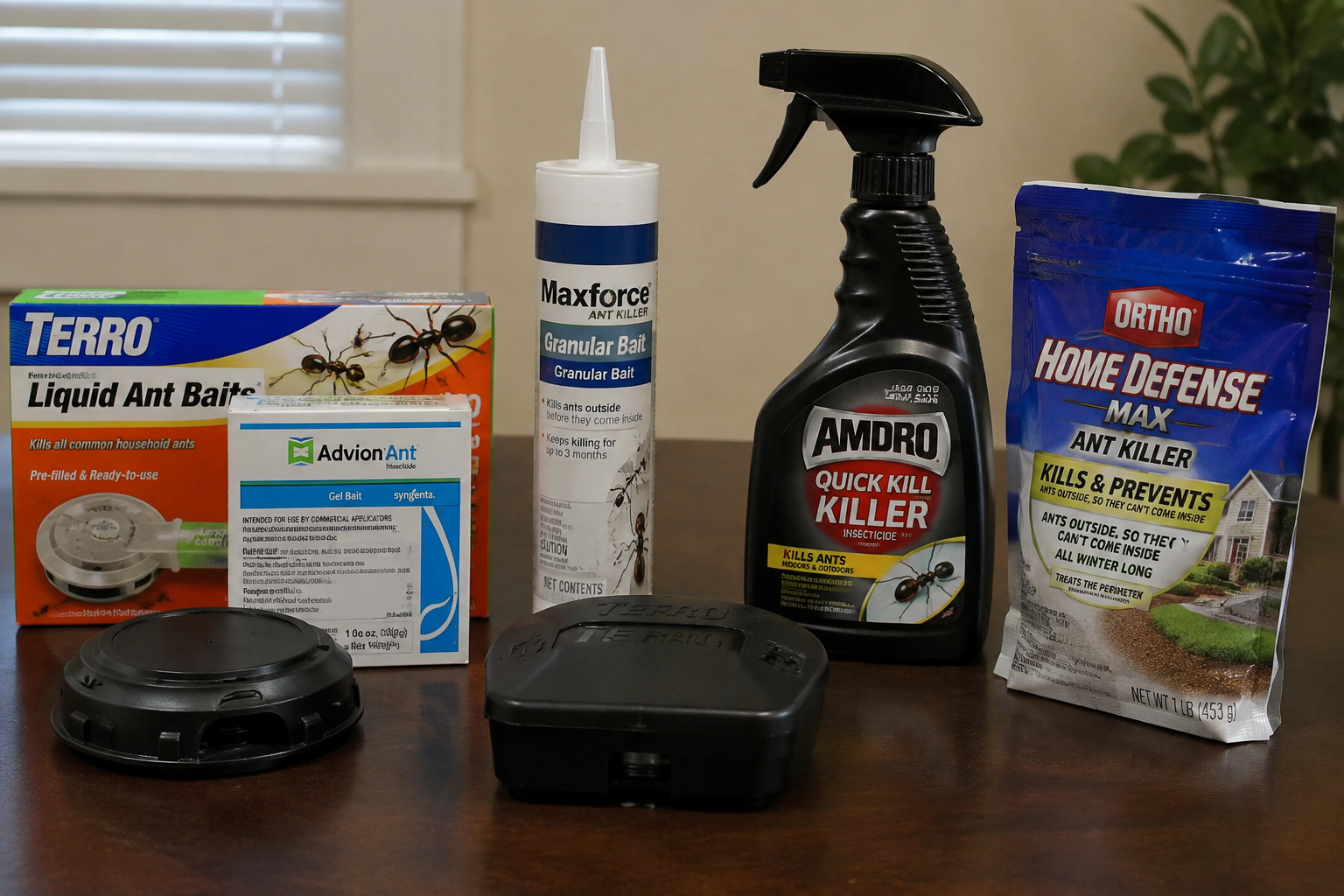
1. Terro Liquid Ant Baits
Consistently ranked among the best ant killers for common household ant species, Terro’s liquid bait stations are a go-to first option for many homeowners.
Product Type: Liquid bait stations Best For: Indoor trails of sugar-loving ants like odorous house ants Key Features: Pre-filled bait stations, borax-based active ingredient, easy placement along trails Advantages: Simple to use, widely available, effective against common household ant species Disadvantages: Less effective against protein-feeding ants like some carpenter ant populations Safety Information: Keep out of reach of children and pets; stations are enclosed but not fully childproof Average Effectiveness: High for sugar ants within one to two weeks Ideal Usage: Place along active trails, not directly on top of ants, and avoid cleaning the area until the colony is eliminated
2. Combat Max Ant Killing Bait Stations
Product Type: Solid bait stations Best For: Ongoing indoor ant prevention Key Features: Child-resistant enclosed stations, long-lasting bait formula Advantages: Discreet design suitable for kitchens and living areas, slow-release action targets the colony Disadvantages: May take one to two weeks for full results, not ideal for large outdoor colonies Safety Information: Enclosed stations reduce accidental contact but should still be placed away from small children and pets Average Effectiveness: Moderate to high for common indoor ant species Ideal Usage: Set multiple stations near baseboards, under sinks, and along entry points
3. Raid Ant & Roach Killer Spray
Product Type: Contact aerosol spray Best For: Fast knockdown of visible ants Key Features: Instant kill formula, residual barrier protection on treated surfaces Advantages: Works immediately, useful for spot-treating trails and entry points Disadvantages: Does not eliminate the colony or queen, may require frequent reapplication Safety Information: Ventilate the area during and after use; avoid spraying near food prep surfaces Average Effectiveness: High for immediate knockdown, low for long-term colony control Ideal Usage: Best combined with a bait product for complete control rather than used alone
4. Amdro Ant Block Home Perimeter Bait
Product Type: Outdoor granular bait Best For: Perimeter treatment around the home’s foundation Key Features: Weather-resistant granules, designed to create a protective barrier Advantages: Long-lasting outdoor protection, targets colonies before they reach the house Disadvantages: Slower acting than sprays, requires reapplication after heavy rain Safety Information: Keep pets and children off treated areas until granules settle Average Effectiveness: High for preventing new colonies near the foundation Ideal Usage: Apply in a band around the home’s perimeter, focusing on garden beds and foundation edges
5. Advion Ant Gel
Often recommended by pest control technicians, Advion is regularly cited as one of the best ant killers for ants that reject sugar-based baits.
Product Type: Professional-grade gel bait Best For: Precision treatment of hard-to-reach indoor cracks and crevices Key Features: Highly attractive bait matrix, effective against a broad range of ant species Advantages: Fast uptake by foraging ants, works on species that reject sweet baits Disadvantages: Requires a bait gun applicator for precise placement, can dry out if exposed to air for long periods Safety Information: Apply only in cracks, crevices, and non-food-contact areas Average Effectiveness: High across multiple ant species, including some carpenter ant populations Ideal Usage: Apply small dots near entry points and known trails rather than large visible amounts
6. Ortho Home Defense Ant Killer Granules
Product Type: Outdoor granules Best For: Lawn and garden ant colonies Key Features: Broadcast or spot-treatment application, long-lasting outdoor formula Advantages: Covers larger outdoor areas efficiently, reduces colony activity near the yard Disadvantages: Not intended for indoor use, effectiveness can diminish with heavy watering Safety Information: Water in lightly after application per label instructions; keep pets off treated lawn until dry Average Effectiveness: Moderate to high for outdoor lawn colonies Ideal Usage: Apply during dry weather and avoid immediate irrigation for best absorption
7. Spectracide Ant Shield Home Barrier Spray
Product Type: Liquid perimeter spray Best For: Creating a barrier around the home’s exterior Key Features: Long-lasting residual formula, rainproof once dried Advantages: Helps prevent ants from entering the home in the first place, easy hose-end or trigger application Disadvantages: Does not target the colony directly, mainly a preventive barrier rather than a cure Safety Information: Allow treated areas to dry fully before allowing children or pets near them Average Effectiveness: High for prevention, low for eliminating existing indoor colonies Ideal Usage: Apply along the foundation, window frames, and doorways as a preventive barrier
8. Syngenta Optigard Ant Gel
Product Type: Professional-grade gel bait Best For: Persistent or resistant indoor ant populations Key Features: Fast-acting yet colony-targeting formula, favored by pest control professionals Advantages: Effective against ants that have shown resistance to other baits, precise application Disadvantages: Typically requires a bait gun and is less commonly stocked in standard retail stores Safety Information: Keep applicator and product away from food-contact surfaces and out of reach of children Average Effectiveness: High, particularly for stubborn infestations Ideal Usage: Apply in small amounts near trails and cracks, replacing dried applications regularly
9. Southern Ag Amdro Fire Ant Bait
Product Type: Granular fire ant bait Best For: Fire ant mounds in yards and open areas Key Features: Formulated specifically for fire ant colonies, mound and broadcast application options Advantages: Effectively targets fire ant queens for full mound elimination Disadvantages: Not effective against other common household ant species Safety Information: Avoid application right before rain; keep children and pets away from treated mounds Average Effectiveness: High specifically for fire ant colonies Ideal Usage: Apply directly around active mounds during dry, calm weather
10. Harris Diatomaceous Earth Ant Killer
Product Type: Natural powder Best For: Homeowners seeking a natural ant killer with minimal chemical exposure Key Features: Food-grade diatomaceous earth, mechanical (non-chemical) mode of action Advantages: Low toxicity, safe to use in cracks and crevices around the home Disadvantages: Loses effectiveness when wet, does not target the queen or eliminate the colony directly Safety Information: Wear a mask when applying to avoid inhaling fine dust Average Effectiveness: Moderate, best used as a supplement to bait-based colony control Ideal Usage: Apply a thin layer in dry areas like along baseboards, behind appliances, or around foundation cracks
Product Comparison Table
The table below summarizes how these best ant killers stack up against each other at a glance.
| Product | Type | Indoor/Outdoor | Targets Colony | Pet Friendly | Best For |
|---|---|---|---|---|---|
| Terro Liquid Ant Baits | Liquid bait | Indoor | Yes | Moderate | Sugar ants indoors |
| Combat Max Bait Stations | Solid bait | Indoor | Yes | Moderate | Ongoing indoor prevention |
| Raid Ant & Roach Spray | Contact spray | Indoor/Outdoor | No | Low (until dry) | Fast visible knockdown |
| Amdro Ant Block Perimeter Bait | Granular bait | Outdoor | Yes | Moderate | Foundation perimeter |
| Advion Ant Gel | Gel bait | Indoor | Yes | Low (apply carefully) | Cracks and crevices |
| Ortho Home Defense Granules | Granules | Outdoor | Partial | Moderate | Lawn colonies |
| Spectracide Ant Shield | Liquid barrier spray | Outdoor | No | Low (until dry) | Preventive barrier |
| Syngenta Optigard Gel | Gel bait | Indoor | Yes | Low (apply carefully) | Resistant infestations |
| Southern Ag Amdro Fire Ant Bait | Granular bait | Outdoor | Yes | Moderate | Fire ant mounds |
| Harris Diatomaceous Earth | Natural powder | Indoor/Outdoor | No | High | Natural, low-toxicity option |
How to Choose the Best Ant Killers for Your Situation
Ant Species
Confirming the species helps determine whether a sweet bait, protein-based bait, or fire-ant-specific product will be most effective.
Infestation Size
A few visible ants may respond well to a single bait station, while an established colony or multiple trails may require a combination of products.
Indoor vs. Outdoor
Indoor problems generally call for baits and gels placed precisely along trails, while outdoor colonies respond better to granules and perimeter treatments.
Children and Pets
Households with young children or curious pets should prioritize enclosed bait stations and natural options over exposed sprays or granules.
Environmental Impact
Natural and low-toxicity options like diatomaceous earth reduce chemical exposure in the yard and around pollinator-friendly gardens.
Ease of Application
Ready-to-use bait stations require little effort, while gels and granules may need a bait gun or broadcast spreader for proper application.
Budget
Basic bait stations and sprays are generally the most affordable entry point, while professional-grade gels tend to cost more but often deliver stronger results against resistant colonies. If rodents are also a concern alongside ants, our rodent damage guide covers similar prevention principles for a whole-home approach.
Safety Tips
Even the best ant killers need to be handled correctly to stay safe around family and pets. Keep the following precautions in mind whichever product you choose.
Storage
Store all ant killer products in their original containers, away from food, and in a location inaccessible to children and pets.
Protective Equipment
Wear gloves when applying gels, granules, or sprays, and avoid direct skin contact with concentrated products.
Child Safety
Choose enclosed bait stations over open bait or spray applications in homes with young children, and always follow label instructions for placement.
Pet Safety
Keep pets away from treated areas until sprays have dried or granules have settled, and store borax-based DIY mixtures well out of reach.
Food Preparation Areas
Avoid applying sprays or gels directly on countertops or surfaces that contact food; apply instead to cracks, corners, and baseboards nearby.
Label Instructions
Always read and follow the manufacturer’s label for application rates, reentry times, and safety precautions, since these vary by product — the EPA’s pesticide label guidance explains what these terms mean in practice.
Proper Disposal
Dispose of empty containers and unused product according to local hazardous waste guidelines rather than regular household trash.
Common Mistakes
Even with one of the best ant killers on hand, these common mistakes can undermine an otherwise solid treatment plan.
- Using the wrong product for the ant species present, such as a sugar-based bait on a protein-feeding colony
- Killing visible ants only, which leaves the queen and colony intact
- Moving bait stations too frequently, which disrupts foraging patterns
- Cleaning bait too soon after application, removing the trail before it reaches the colony
- Ignoring entry points, allowing new ants to continue entering even after treatment — see our guide to preventing ants in your home for sealing tips
- Mixing incompatible products, such as combining a repellent spray with a bait, which can cause ants to avoid the bait entirely
DIY vs. Commercial Products
Homemade solutions can help in a pinch, but they rarely match the consistency of the best ant killers sold commercially. Here’s how the two approaches compare.
| Factor | DIY Methods | Commercial Products |
|---|---|---|
| Cost | Low | Low to moderate |
| Effectiveness | Variable, often limited | Generally higher and more consistent |
| Speed | Slower | Ranges from instant (sprays) to gradual (baits) |
| Long-Term Results | Limited against established colonies | Better suited for full colony elimination |
| Best Situations | Minor trails, prevention, low-toxicity preference | Established colonies, recurring infestations |
Frequently Asked Questions
What is the best ant killer? The best ant killers depend on the ant species and location of the infestation — baits and gels are generally best for eliminating indoor colonies, while granules work well for outdoor perimeter protection.
Do ant baits kill the queen? Yes, effective baits are designed to be carried back to the nest by worker ants, eventually reaching and killing the queen, which is necessary for full colony elimination.
Are ant sprays better than baits? Sprays offer faster visible results but generally don’t reach the queen or colony, while baits work more slowly but provide longer-lasting control.
Are natural ant killers effective? Natural options like diatomaceous earth and vinegar can help manage minor ant activity but are typically less effective than formulated baits against established colonies.
Which ant killer is safe around pets? Enclosed bait stations and food-grade diatomaceous earth are generally considered safer choices around pets compared to open sprays or granules.
How long do ant baits take to work? Most ant baits take one to two weeks to fully eliminate a colony, since the process depends on worker ants sharing the bait with the rest of the nest.
Can ants become resistant to certain products? Some ant populations can show reduced response to specific active ingredients over time, which is why rotating between different bait formulas can help maintain effectiveness.
Which products work best outdoors? Granular baits and perimeter sprays are generally best suited for outdoor use, particularly for lawn colonies and fire ant mounds.
How often should I treat for ants? Treatment frequency depends on the product and infestation severity, but many homeowners reapply preventive barriers seasonally and monitor bait stations monthly.
When should I call a professional? Contact a licensed pest control company near you if the infestation persists despite consistent treatment, involves carpenter ants near structural wood, or covers a large outdoor area.
Conclusion
There’s no single product among the best ant killers of 2026 that works for every situation — the right choice depends on the ant species, whether the problem is indoors or outdoors, and how established the colony has become. Baits and gels are generally best for full colony elimination, sprays offer fast but temporary knockdown, and granules provide longer-lasting outdoor protection.
Before choosing a product, take the time to properly identify the ant species you’re dealing with, since this single step often determines whether a treatment succeeds or fails. For a broader look at other common invaders, see our household pest guide. If an infestation persists despite consistent effort, or involves carpenter ants near structural wood, find a licensed local pest control professional who can identify the colony’s location and apply a more targeted treatment.
- Ant identification guide — linked in “Why Choosing the Right Ant Killer Matters”
- How to prevent ants in your home — linked in “Common Mistakes”
- Household pest guide — linked in the Conclusion
- Integrated pest management guide — linked in “Long-Term Control”
- Find local pest control — linked in the FAQ and Conclusion
- Pest identifier tool — linked in “Different Ant Species”
- Rodent damage guide — linked in “How to Choose the Best Ant Killers”
- Seasonal pest guide — linked in the Introduction
External References
- U.S. Environmental Protection Agency (EPA) – Safer Choice and Pesticide Safety – guidance on using pesticide products safely
- Centers for Disease Control and Prevention (CDC) – Pesticide-Related Illness – health and safety information related to pesticide exposure
- U.S. Department of Agriculture (USDA) – Animal and Plant Health Inspection Service – research on invasive ant species, including fire ants
- University Extension Services – National Institute of Food and Agriculture – find your state’s land-grant extension office for regional ant identification and control guidance