Waking up with unexplained, itchy red welts or spotting strange dark spots on your sheets can instantly trigger panic. Bed bugs are among the most challenging and emotionally distressing household pests to deal with. Because they’re elusive, small, and primarily active while you sleep, an infestation can grow unnoticed for weeks.
Accurate bed bug identification is vital. Misidentifying these pests often leads to ineffective treatments that cause the bugs to scatter, worsening the problem. This guide will teach you exactly what bed bugs look like, how to spot early signs, and how to safely regain control of your home.
Table of Contents
What Are Bed Bugs?
Bed bugs are small, parasitic insects that feed exclusively on the blood of warm-blooded animals, with humans as their preferred host. Getting the basics right here is the foundation of accurate bed bug identification.
- Scientific overview — Cimex lectularius, belonging to the family Cimicidae, insects specialized for blood-feeding
- Common names — bed bugs, wall lice, mahogany flats, crimson ramblers
- Basic characteristics — wingless, nocturnal crawlers that don’t build nests but live in tight, hidden clusters near their hosts
How to Identify Bed Bugs
For accurate bed bug identification, look for these physical traits:
- Size — adults are about 1/4 inch (5–7 mm), roughly an apple seed; nymphs can be as small as a pinhead
- Shape — flat and broadly oval when unfed, swelling into an elongated cylinder after feeding
- Color — unfed adults are mahogany or reddish-brown; nymphs are translucent or pale yellow, turning deep crimson after feeding
- Body appearance — segmented and covered in fine hairs giving a faintly banded look
- Legs — six legs built for crawling, not jumping or flying
- Antennae — four-segmented antennae pointing forward
- Distinctive features — a small head with compound eyes and a folded, three-segmented beak used for feeding
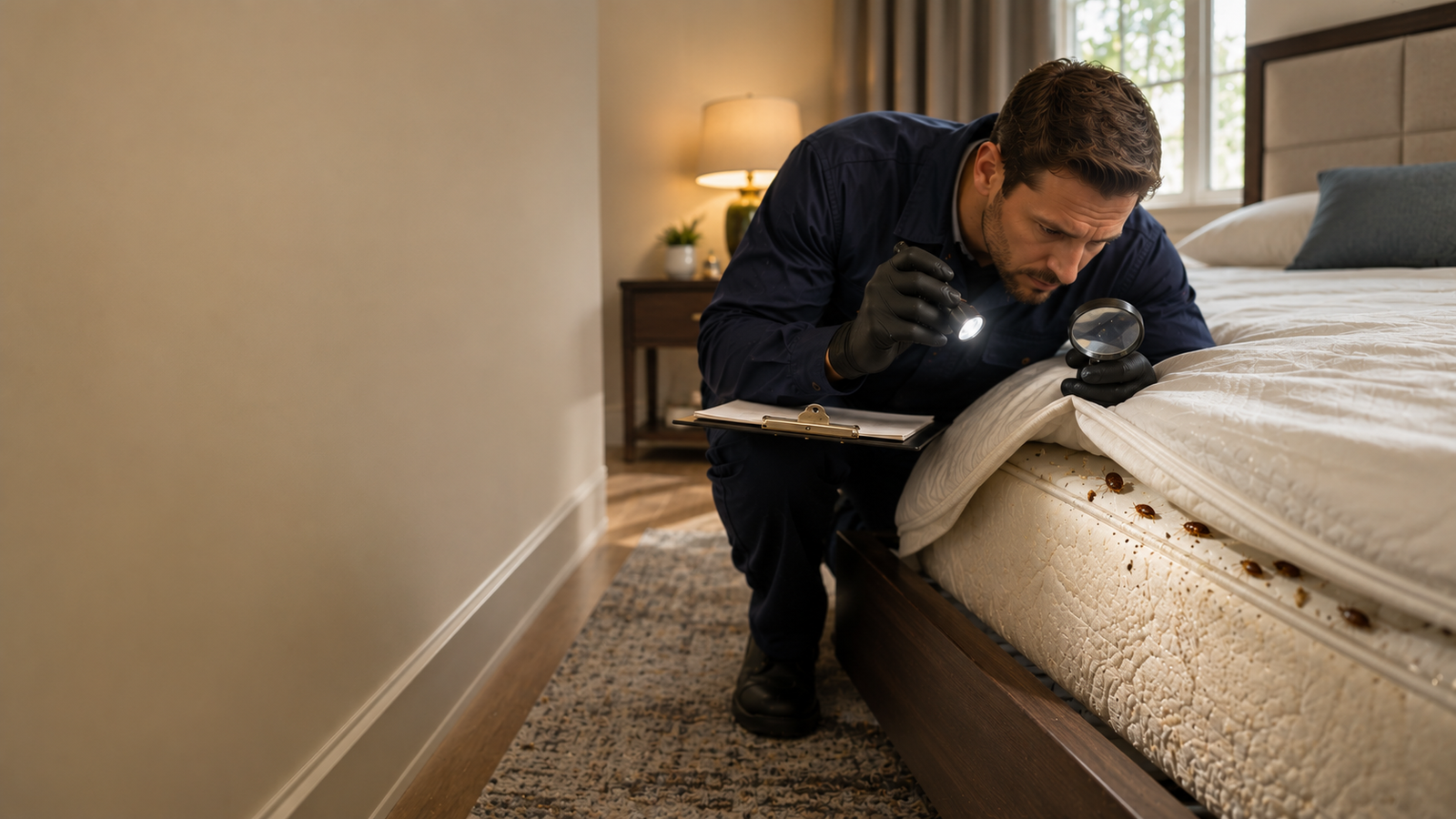
(When publishing, add images at these points: an unfed adult next to an apple seed for scale, nymphs at different stages, macro shots of eggs, a fed-vs-unfed comparison, typical bite patterns, a mattress seam infestation, fecal spots on a sheet, and shed skins on wood slats.)
Signs of a Bed Bug Infestation
You don’t always need to see a live insect to confirm bed bug identification. Watch for these signs:
- Dark fecal spots — tiny black ink-like marks that smear slightly if wiped with a damp cloth
- Blood stains on sheets — small drops from an accidentally crushed engorged bug
- Shed skins — thin, translucent, amber shells left behind after each of five molts
- Bed bug eggs — tiny, pearly-white, rice-grain-like structures glued into dark crevices
- Live bed bugs — insects tucked into seams, tufts, and joints of bedroom furniture
- Bite patterns — itchy welts in a line or cluster of three or four, sometimes called “breakfast, lunch, and dinner”
- Musty odor — a sweet, musty smell from alarm pheromones in severe infestations
Where Are Bed Bugs Commonly Found?
Knowing their hiding spots is just as important to bed bug identification as knowing what they look like:
- Mattresses and box springs — under buttons, tufts, tags, and piping seams; check the box spring’s plastic corners and dust cover
- Bed frames and furniture — wooden slats, headboard brackets, screw holes, and nearby upholstery seams
- Hotels and apartments — through wall voids, electrical conduits, and shared pipe chases between units
- Luggage and clothing — crawling into suitcase seams or folded laundry left on hotel racks
- Cracks and crevices — behind wallpaper, moldings, baseboards, outlets, and even inside alarm clocks
Common Look-Alikes
Many people get bed bug identification wrong by misidentifying harmless insects as bed bugs:
| Pest | Similarities | Differences | How to Identify Correctly |
|---|---|---|---|
| Bed Bug | Flat, oval, reddish-brown, wingless | Horizontal segments, bites for blood meals | Apple-seed shape with dark fecal spotting nearby |
| Carpet Beetle | Small, oval, found near fabrics | Hard-shelled, patterned, can fly; larvae are hairy | Check for wings and patterned shell; eats fabric, not blood |
| Bat Bug | Nearly identical size and color | Long hairs on thorax longer than eye width | Needs a microscope; lives near bats in attics |
| Flea | Small, brown, blood-feeding | Flattened side-to-side, jumps long distances | Watch the movement — jumping means flea, not bed bug |
| Booklouse | Small, pale, similar to a young nymph | Soft body, prominent head, long antennae | Quick movement on damp books; feeds on fungi, not blood |
Life Cycle
Bed bugs undergo gradual metamorphosis, requiring a blood meal at each stage: Egg → 5 Nymphal Stages → Adult
- Egg — 1 to 5 laid daily, glued into hidden cracks, hatching in 6 to 10 days
- Nymph — passes through five instars, needing a blood meal before each molt
- Adult — feeds every 3 to 7 days if a host is available
- Lifespan — typically 4 to 6 months, up to a year in cooler conditions without feeding
Are Bed Bugs Dangerous?
- Bites — reactions vary widely, from no signs at all to intensely itchy, swollen welts
- Allergic reactions — heavy scratching can cause secondary infections; severe anaphylaxis is rare
- Disease transmission — bed bugs don’t transmit infectious diseases, unlike mosquitoes or ticks
- Mental health impacts — anxiety, insomnia, and hypervigilance are common with active infestations
- Pets — will bite dogs and cats if no human host is available, though they prefer human skin
What Attracts Bed Bugs?
- The primary driver — human body heat, exhaled CO2, and natural body odors
- The misconception — they aren’t attracted to dirt or poor hygiene, thriving equally in luxury resorts and cluttered homes
- Risk factors — clutter doesn’t attract them but makes detection harder; frequent travel and secondhand furniture are the most common ways infestations start
How to Confirm Identification
- Perform a nighttime inspection — check mattress and headboard seams around 2–4 AM, their peak activity period.
- Install interceptor traps — plastic cups under bed legs let bugs climb in but not escape.
- Use the card trick — run a stiff card along mattress piping and headboard cracks to dislodge hidden bugs or eggs.
- Preserve your specimen — clear tape or a sealed bag captures an intact sample for confirmation.
What to Do Next
Immediate DIY defense steps:
- Isolate your bed — move it 6 inches from walls and keep bedding off the floor
- Heat treat your linens — wash and dry on the highest heat for at least 30 minutes to kill all life stages
- Vacuum safely — use a crevice tool on seams and joints, then seal and discard the bag outdoors immediately
When to call a professional — if bugs have spread into multiple rooms or you’re in a multi-unit building, hire a licensed professional. They have whole-room heat equipment, professional-grade treatments, and canine scent-detection units for complete eradication.
Frequently Asked Questions
Can bed bugs jump or fly? No. They have no wings and can’t jump — they move exclusively by crawling.
Can you see bed bug eggs? Yes, though small at about 1 mm, they’re visible as tiny translucent-white cylinders glued in clusters.
Do bed bugs only come out at night? Mostly, but they’ll adjust their schedule and feed during the day if hungry and their host sleeps then.
Can bed bugs live on your body? No. They feed for a few minutes then return to nearby hiding spots — they don’t live on skin or hair.
How long can bed bugs live without feeding? About 2 to 3 months at room temperature, longer in cooler conditions as their metabolism slows.
What kills bed bugs instantly? Direct heat above 120°F kills all life stages instantly; rubbing alcohol or direct sprays also work on contact.
Do bed bug bites always itch? No — reactions depend on individual immune response, from no reaction to severe itching and swelling.
Can you get bed bugs from a clean hotel? Yes. They’re brought in by previous guests, not poor housekeeping, so even luxury hotels can be affected.
Key Takeaways
- The visual identification — flat, oval, reddish-brown adults resembling apple seeds; tiny translucent nymphs turning red after feeding
- The key signs — black, ink-like fecal spots and translucent amber shed skins near mattress seams
- The hiding habits — close proximity to beds, couches, and seating where humans rest
- The real risk — no disease transmission, but real potential for skin infections and psychological stress
Getting bed bug identification right early is what keeps a manageable problem from spreading through your whole home — and it starts with knowing exactly what to look for on your own mattress and furniture. For related reading, see our Bed Bug Resurgence guide, our Pest Control overview, our Signs of Pest Damage guide, or our DIY Pest Control guide.
Sources: CDC: Bed Bugs FAQs · EPA: Bed Bug Identification and Management · Virginia Tech Department of Entomology: Bed Bug Biology · University of Minnesota Extension: Inspecting for Bed Bugs · Rutgers University: Bed Bug Resource Center