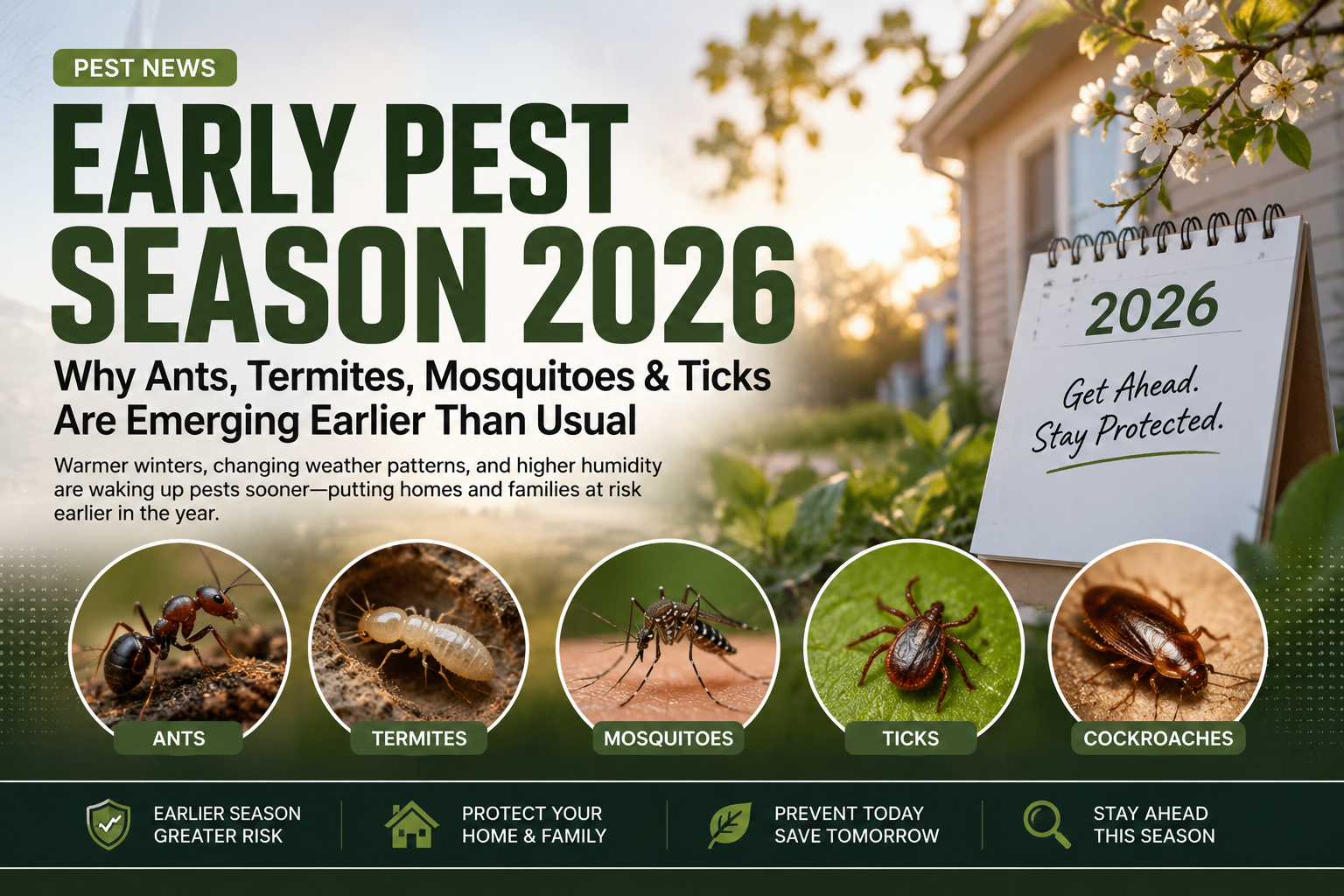
Early Pest Season 2026 is already underway, and homeowners across the United States are opening their doors to a familiar but unwelcome surprise: pests that normally wait until late spring are already on the move. Ants are trailing across kitchen counters in February. Termite swarms are appearing weeks ahead of schedule. Mosquitoes are hatching before the last frost has fully cleared. This isn’t a fluke or a one-region story — it’s a nationwide pattern, and pest control experts say 2026 is shaping up to be one of the earliest and most active pest seasons in recent memory.
The reasons trace back to an unusual winter. Much of the country saw a strange mix of brutal cold snaps and heavy snowfall, followed by a milder, drier start to spring. That combination sounds harsh for insects, but it actually works in their favor. Deep snowpack insulates the soil, protecting overwintering pests from the hard freezes that would normally thin their numbers. When warmer temperatures arrive early, those surviving populations wake up sooner — and in greater numbers — than usual.
For homeowners, that means the pest prevention window that typically opens in April or May has already started narrowing. This article breaks down what’s driving Early Pest Season 2026, which pests to watch for, which states face the highest risk, and what homeowners and pest professionals can do to get ahead of it.
Table of Contents
What Is Causing Early Pest Activity in 2026?
Pest emergence timing is governed almost entirely by temperature, moisture, and daylight. When any of those shift earlier in the year, insect and rodent activity shifts with them. Several overlapping factors are driving Early Pest Season 2026 and this year’s early start.
Warmer temperatures. Soil and air temperatures are the primary trigger for pest emergence from winter dormancy. Even a few degrees of above-average warmth in late winter can be enough to rouse ants, termites, and other overwintering insects weeks ahead of their typical schedule.
Shorter winters. A compressed cold season means less time for natural die-off. Many insects survive winter by going dormant, not by dying outright, so a shorter or milder winter simply means more of them make it to spring alive and ready to reproduce.
Increased humidity and rainfall. Damp conditions are ideal breeding grounds for mosquitoes, termites, and cockroaches. Standing water from spring storms, combined with humidity, accelerates larval development and colony growth.
Insulating snowpack. Counterintuitively, heavy snow cover during a cold winter can protect pests underground rather than kill them, since snow acts as a thermal blanket over the soil.
Shifting climate patterns. Longer-term climate trends are gradually extending the frost-free season in most of the country, which lengthens the window during which pests can remain active, reproduce, and expand their range into areas that were previously too cold for them. Read more on climate change and pest population growth.
Urban and suburban expansion. As development pushes into wooded and agricultural land, homes are built closer to the natural habitats of ants, ticks, and rodents, increasing the odds of early encounters as those pests search for food and shelter near structures.
Together, these factors create what entomologists sometimes describe as a “domino effect” — winter conditions that let more pests survive, followed by a warm, wet spring that gives them everything they need to become active and start breeding ahead of schedule.
Which Pests Are Emerging Earlier?
Not every pest responds to warm weather the same way. Here’s a breakdown of the species behind Early Pest Season 2026, why they’re active weeks ahead of usual, and what homeowners should watch for.
Ants
Ants are often the first pest homeowners notice each year, and 2026 is no exception. As soil temperatures rise, ant colonies that spent the winter dormant underground become active again, sending worker ants out in search of food. Warm, wet spring conditions are accelerating this process in many regions, pushing ant activity indoors earlier as colonies forage for moisture and sugar sources inside homes. See our full guide to ant control methods for homeowners for step-by-step treatment options.
Termites
Termites are one of the biggest early-season concerns because their activity is directly tied to structural damage. Warming soil and drier spring conditions are accelerating swarming season in several regions, meaning winged reproductive termites are taking flight — and starting new colonies — earlier than in past years. Early swarms give homeowners less time to notice warning signs before damage begins. Learn how to identify termite damage before it spreads.
Mosquitoes
Mosquitoes need standing water and warm temperatures to complete their life cycle, and both are arriving sooner this year. A wetter spring combined with earlier warmth is allowing mosquito eggs to hatch and mature faster, and forecasters expect activity to spike further with summer storms that leave behind pools of standing water. The EPA’s mosquito control guidance recommends eliminating standing water as the single most effective prevention step — see our mosquito prevention tips for your yard for a full checklist.
Ticks
Warmer spring conditions are triggering an earlier tick season in multiple regions of the country. Ticks become active once temperatures consistently rise above freezing, and a shorter winter gives them more months of the year to seek hosts, raising the window of exposure for both people and pets. Review the signs of a tick infestation at home to catch activity early.
Cockroaches
Cockroaches thrive in warm, humid environments, and rising temperatures combined with late-season rainfall are expected to spike their activity, particularly indoors as they seek moisture. Cockroach pressure typically builds through summer, but an early warm-up gives populations a head start. Our cockroach prevention checklist covers the moisture and food-source fixes that matter most.
Rodents
While rodents are active year-round, early warm weather increases outdoor food availability and can accelerate breeding cycles, a pattern the USDA also tracks in its agricultural pest-impact research. Mice and rats that sought shelter indoors during winter cold snaps may already be established in walls, attics, and crawl spaces, making early-season inspections especially important — start with our rodent-proofing your home guide.
States Most Likely to Experience Increased Pest Pressure
Early Pest Season 2026 isn’t hitting every state equally. Regional forecasts from the National Pest Management Association’s Bug Barometer point to several states facing a particularly active season this year, largely due to a combination of mild winters, wet springs, and long growing seasons.
| State | Why Pest Pressure Is Rising Earlier |
|---|---|
| Florida | Year-round warmth and high humidity support continuous breeding of mosquitoes, termites, and ants with little seasonal slowdown |
| Texas | A large, warm land area combined with spring rainfall creates ideal conditions for ants, termites, and mosquito breeding sites |
| California | Wide climate variation means coastal and inland areas both see early ant, rodent, and termite activity as temperatures rise |
| Georgia | Warm, wet spring conditions in the Southeast are expected to boost termite, mosquito, and ant activity earlier than in past years |
| North Carolina | A mild winter followed by a drier spring is jumpstarting termite swarms and stinging insect activity ahead of schedule |
| Arizona | Dry heat arrives early and drives scorpions, ants, and cockroaches to seek moisture indoors sooner in the season |
Homeowners in these states should expect the traditional pest season to arrive several weeks ahead of typical timelines, with less lead time to complete preventive treatments before pests are already active. Research from University Extension Services such as University of Florida IFAS supports this pattern in regional pest biology studies. Florida residents in particular should review our pest control tips for Florida homeowners given the state’s year-round breeding conditions.
How Early Pest Activity Affects Homeowners
Early Pest Season 2026 isn’t just an inconvenience — it carries real financial, structural, and health consequences for homeowners who aren’t prepared. Understanding how much termite treatment costs helps put the stakes of an early infestation into perspective.
Property damage. Early termite swarms mean colonies can establish themselves and begin feeding on structural wood before homeowners even realize a problem exists. The earlier the infestation starts, the more time it has to cause damage before detection.
Health risks. Mosquitoes and ticks are both vectors for disease. An extended active season means more months of potential exposure to mosquito-borne illnesses and tick-borne diseases like Lyme disease, according to guidance from the CDC, increasing the importance of early prevention rather than waiting until peak summer to take action.
Allergies. Cockroach droppings and shed skin are common indoor allergens and asthma triggers. Earlier cockroach activity means a longer window of exposure for sensitive individuals, particularly in humid climates.
Food contamination. Ants, cockroaches, and rodents are all capable of contaminating stored food and kitchen surfaces. An earlier start to their active season means kitchens need pest-proofing sooner than homeowners might typically plan for.
Repair costs. Structural pests like termites and rodents can cause damage that’s expensive to repair, particularly when infestations go undetected for extended periods. Early activity compresses the window homeowners have to catch problems before they become costly.
Expert Prevention Tips
To get ahead of Early Pest Season 2026, pest professionals recommend homeowners move up their seasonal pest control calendar rather than waiting for the traditional spring pest season to begin. Here are practical steps to take now.
- Schedule an early inspection. A licensed pest control professional can identify early warning signs — such as termite mud tubes, ant trails, or rodent droppings — before an infestation takes hold.
- Seal exterior entry points. Caulk gaps around windows, doors, utility lines, and foundation cracks to block ants, rodents, and other pests from entering as they become active.
- Eliminate standing water. Empty gutters, flowerpots, birdbaths, and any containers that collect rainwater to cut off mosquito breeding sites before eggs are laid.
- Trim vegetation and mulch away from the foundation. Overgrown shrubs and mulch piles that touch the house create moisture-rich pathways for ants, termites, and ticks to reach the structure.
- Check crawl spaces and attics. These areas are common entry and nesting points for rodents and termites, and early-season checks catch problems before they spread.
- Store firewood away from the house. Woodpiles stacked against exterior walls are a common termite and ant highway into the home.
- Treat pets for ticks and fleas early. Starting preventive treatments before peak tick season reduces the risk of pets — and by extension, people — being exposed.
- Repair window and door screens. Torn or ill-fitting screens are an easy entry point for mosquitoes and flying insects as temperatures rise.
- Reduce indoor moisture. Fix leaky pipes and use dehumidifiers in damp areas like basements to make the environment less attractive to cockroaches and ants.
- Consider a preventive treatment plan. Many pest control companies offer early-season treatments specifically designed to address termite swarms, ant colonies, and mosquito breeding before populations peak.
What This Means for Pest Control in 2026
Early Pest Season 2026 is changing how the pest control industry approaches the year. Rather than a defined spring-to-fall pest season, professionals are increasingly treating pest pressure as a longer, more continuous concern.
Longer pest seasons. With pests emerging earlier and remaining active later into fall, the traditional “pest season” is stretching on both ends, requiring homeowners and professionals alike to rethink seasonal timelines.
More inspections. Pest control companies are seeing increased demand for early-season inspections, as homeowners look to catch termite swarms, ant colonies, and rodent activity before it escalates.
Preventive treatments. Rather than waiting for visible infestations, more homeowners are opting for proactive treatments timed to the earlier emergence patterns rather than the calendar dates used in past years.
Professional monitoring. Ongoing monitoring programs — particularly for termites — are becoming more valuable as swarm timing becomes less predictable from year to year, making a single annual inspection less reliable on its own.
Pest professionals generally agree that the best defense against an early, active season is to move prevention efforts up on the calendar rather than waiting for visible signs of a problem.
Frequently Asked Questions
Why are pests showing up earlier in 2026? Early Pest Season 2026 is the result of a milder winter start, insulating snowpack that helped pests survive the cold, and a warm, wet spring that’s allowing many species to become active weeks ahead of their typical schedule.
Is early pest activity linked to climate change? Long-term warming trends are gradually extending the frost-free season across much of the country, which lengthens the period during which pests can remain active and reproduce. This year’s specific early start is also tied to short-term winter and spring weather patterns.
Which pests are emerging earliest this year? Termites, ants, mosquitoes, and ticks are among the pests showing the earliest activity in 2026, with regional variation depending on local weather conditions.
Are termites more dangerous when they swarm early? Early swarms give new colonies more time to establish and begin feeding on structural wood before homeowners notice warning signs, which can increase the risk of undetected damage.
How can I tell if I have an early termite problem? Look for mud tubes along foundation walls, discarded wings near windows and doors, and wood that sounds hollow when tapped. A professional inspection is the most reliable way to confirm activity.
Does an early pest season mean a worse pest season overall? Not necessarily worse, but typically longer. Early emergence generally means pests have more months to reproduce, which can lead to larger populations by the time summer arrives.
Should I start mosquito prevention before summer? Yes. Eliminating standing water and addressing breeding sites in spring, before eggs are laid, is far more effective than trying to control adult mosquito populations later in the season.
Are certain states more affected by early pest activity? States with warm, humid climates or a wet spring following a mild winter — including parts of the Southeast, Gulf Coast, and Southwest — tend to see the earliest and most pronounced pest activity.
Can I prevent pests without hiring a professional? Homeowners can reduce risk significantly through sealing entry points, removing standing water, and maintaining yards, but professional inspections are recommended for structural pests like termites, which can cause damage that isn’t visible until it’s advanced.
When is the best time to schedule a pest inspection in 2026? Given the early start to pest activity this year, professionals recommend scheduling inspections in late winter or early spring rather than waiting until traditional peak season in late spring or summer.
Conclusion
Early Pest Season 2026 is arriving ahead of schedule, and the reasons are clear: a winter that insulated more pests than it killed, followed by a warm, wet spring that’s giving ants, termites, mosquitoes, ticks, and other pests everything they need to become active early. For homeowners, that means the usual timeline for pest prevention no longer applies — waiting until late spring to inspect and treat a home could mean missing the early window when problems are easiest to catch.
The most effective response is a proactive one. Scheduling an early inspection, sealing entry points, removing standing water, and addressing vulnerabilities around the home now — rather than after pests are already active — can make the difference between a minor nuisance and a costly infestation. With pest seasons trending longer and less predictable, getting ahead of the calendar has never been more important.