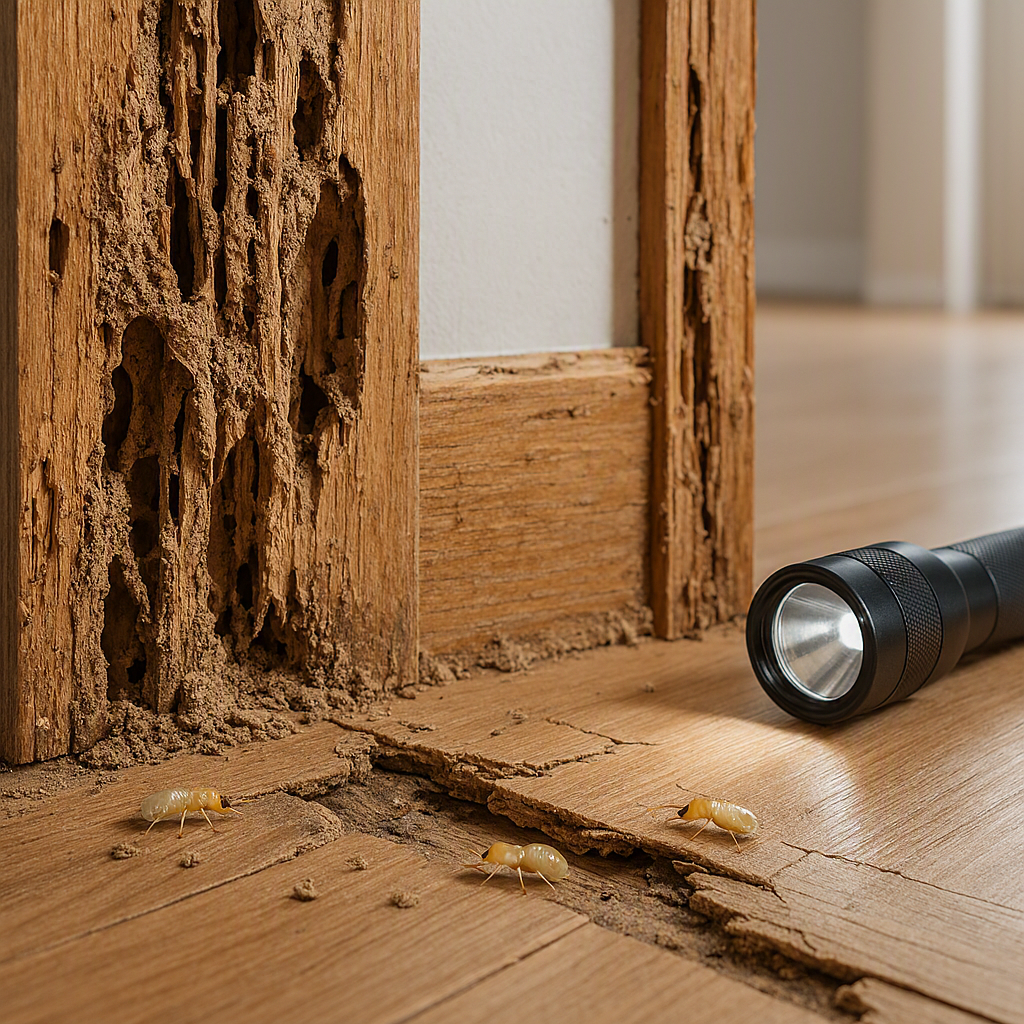
If you’ve found small piles of sawdust-like material near a windowsill, deck post, or baseboard, you may be looking at your first clue of carpenter ant damage. Unlike termites, carpenter ants don’t eat wood for food — they chew through it to carve out tunnels and nesting chambers, and they tend to do it quietly, inside walls and beams, for months or years before anyone notices.
That’s what makes this pest so easy to underestimate. A few large black ants on the kitchen counter don’t look like much of a threat. But by the time carpenter ants are visible indoors in numbers, there’s a reasonable chance a colony has already settled into a damp, hidden part of your home’s structure.
This guide walks through exactly what carpenter ant damage looks like, why it happens, what it costs to fix, and how to tell it apart from far more expensive termite damage — plus the DIY and professional treatment options that actually work.
Table of Contents
What Is Carpenter Ant Damage?
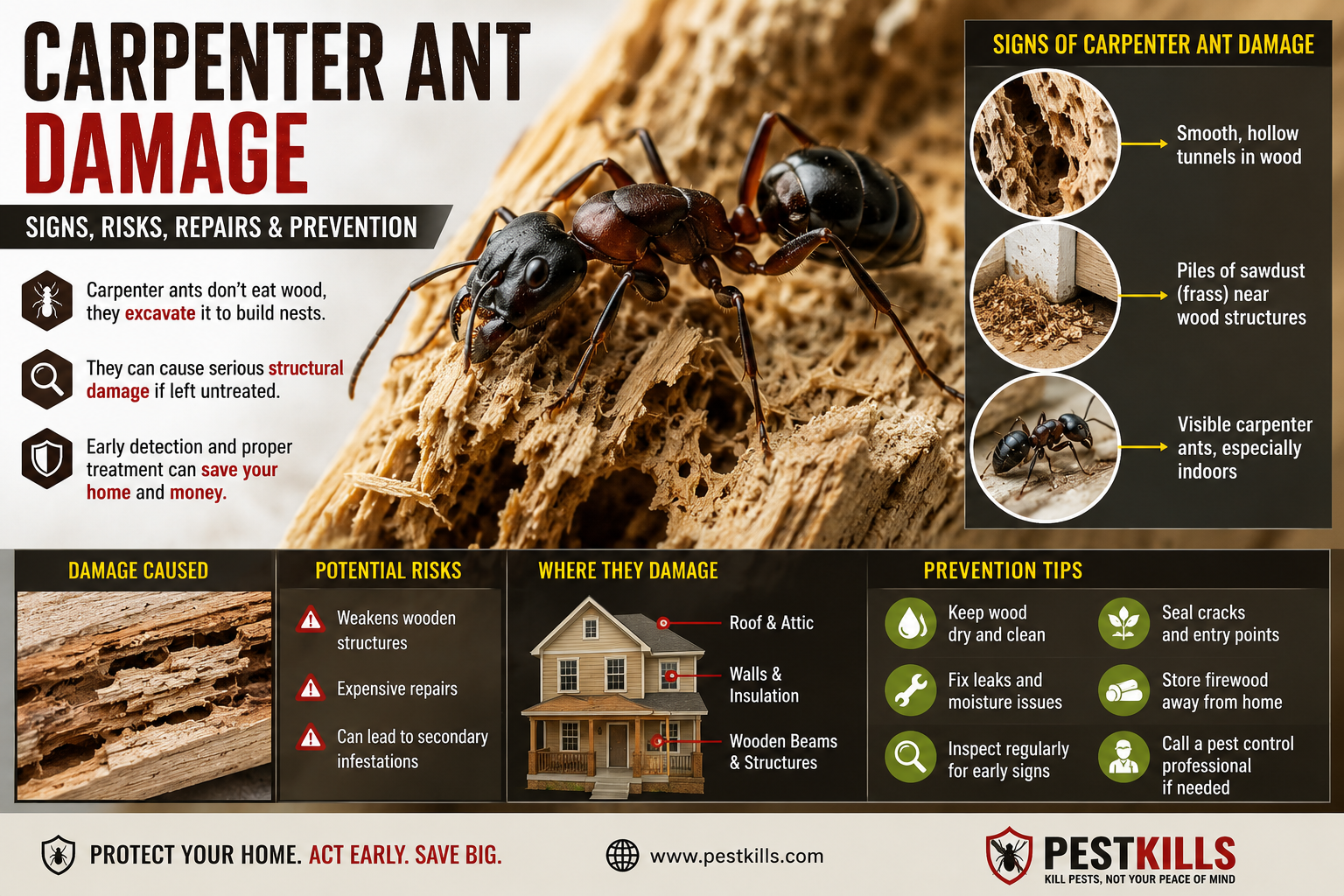
Carpenter ant damage is the structural wear that happens when Camponotus ants excavate wood to build a nest. Worker ants use their mandibles to remove wood fiber by fiber, leaving behind smooth, sand-papery tunnels called galleries.
A key fact that trips up a lot of homeowners: carpenter ants do not consume the wood they remove. Multiple university extension entomology programs confirm that, unlike termites, carpenter ants excavate wood purely for shelter and discard what they remove as debris rather than digesting it.
That debris — called frass — is usually the first physical evidence people find. It looks like coarse pencil shavings, sometimes mixed with dead ant body parts, pushed out through small “kick-out” holes in the wood.
Left alone, a colony can spend years quietly enlarging its galleries. The damage is rarely dramatic at first. It becomes a real problem when tunnels expand enough to compromise a beam, sill plate, window frame, or deck post.
Why Carpenter Ants Invade Homes
Carpenter ants are, in nature, a normal and even beneficial part of a forest ecosystem — they help break down dead trees, stumps, and fallen logs. The problem starts when a colony decides your house looks like a good extension of that habitat.
A colony typically begins outdoors: in a rotting stump, a dead tree limb, or a buried root. As it grows, the original (“parent”) colony can send out worker ants to establish satellite colonies in nearby structures. Indoor satellite nests are common because they tolerate drier conditions than the parent nest, as long as there’s still a pocket of damp or decaying wood to start in.
In other words, carpenter ants don’t “attack” a healthy house. They respond to an existing moisture problem — and then make it worse by weakening the wood around it.
Common Causes of Infestation
Most indoor carpenter ant problems can be traced back to a handful of recurring conditions:
- Existing water damage — roof leaks, plumbing leaks, or condensation that has already softened wood
- Poor drainage around the foundation, which keeps sill plates and crawl space framing damp
- Firewood stored against the house or brought inside without inspection
- Tree branches or vines touching the roofline, which act as a bridge from an outdoor nest
- Clogged gutters that overflow onto fascia boards and eaves
- Old, untreated wood in contact with soil, such as deck posts or porch columns
- Poor attic or crawl space ventilation, which traps humidity against framing
Notice that almost every item on that list is really a moisture-management issue. That’s why pest professionals so often say that treating the ants without fixing the underlying water problem only buys you a temporary win.
Types of Carpenter Ants in the U.S.
Carpenter ants belong to the genus Camponotus, one of the largest ant genera in the world. Worldwide estimates put the number of Camponotus species at more than 900, with roughly 50 found across the United States and Canada, according to Utah State University Extension. Not every species nests in structural wood, but several are well-known home invaders.
Species homeowners are most likely to encounter include:
- Black carpenter ant (Camponotus pennsylvanicus) — the most widespread species in the eastern U.S. and the first North American ant ever formally described, back in 1773
- Florida carpenter ant (Camponotus floridanus) and the Tortugas carpenter ant — common across the Gulf Coast and Florida
- New York carpenter ant (Camponotus novaeboracensis) — similar in size to the black carpenter ant but not uniformly black
- Smaller carpenter ant (Camponotus nearcticus) — a much smaller species, often only about 5–7 mm long
- Red (ferruginous) carpenter ant (Camponotus chromaiodes) — black with a reddish midsection, found in parts of the Northeast
Regionally, the exact mix varies. Rutgers Cooperative Extension notes that eight Camponotus species are common in the northeastern U.S. alone, while Utah’s extension service documents about a dozen locally. A pest control professional can identify the species with a hand lens or microscope, which matters because bait preference can shift somewhat between species.
Early Warning Signs of Carpenter Ant Damage
Because the ants nest inside wood rather than on top of it, early warning signs of carpenter ant damage tend to be subtle. Here’s what to watch for, roughly in the order most homeowners actually notice them:
- Frass piles — small heaps of shredded wood, sometimes with ant fragments mixed in, below tiny slit-like openings
- Large black (or black-and-red) ants indoors, especially foraging at night in kitchens or bathrooms
- Rustling or faint crinkling sounds inside walls or ceilings, most noticeable after dark
- Winged swarmers indoors — reproductive ants with wings, usually seen at windows in spring, are a strong sign of a mature nest inside the structure
- Hollow-sounding wood when tapped with a knuckle or screwdriver handle
- Discolored, softened, or warped wood, particularly near plumbing, rooflines, or window frames
- Shed wings collected on windowsills or in spiderwebs
💡 Expert Tip: Winged ants outdoors just mean a colony exists somewhere nearby — that’s normal. Winged ants found indoors, especially clustered at a window trying to reach daylight, are a much stronger signal that the nest is inside your walls.
How to Identify Carpenter Ant Damage vs. Termites
Carpenter ants and termites are the two pests homeowners confuse most often, largely because both can produce winged swarmers around the same time of year and both are associated with wood damage. Fortunately, the two are easy to tell apart once you know what to look for.
Signs of Carpenter Ant Damage vs. Termite Damage
| Feature | Carpenter Ants | Termites |
|---|---|---|
| Do they eat the wood? | No — they excavate and discard it | Yes — wood is their food source |
| Tunnel appearance | Smooth, clean, “sandpapered” galleries | Rough tunnels, often packed with mud or soil |
| Tunnel direction | Mostly across the wood grain | Follows the wood grain |
| Debris left behind | Frass (wood shavings + ant parts) pushed outside the nest | Mud tubes; no frass piles |
| Antennae | Elbowed (bent) | Straight, beaded |
| Wings (swarmers) | Two different wing lengths | Two pairs of equal-length wings |
| Body shape | Pinched, narrow waist | Thick waist, no pinch |
| Typical body color | Black, or black and red/brown | Cream, tan, or pale brown |
| Preferred wood condition | Damp or decaying wood | Any wood, dry or moist |
| Typical repair cost | Hundreds to a few thousand dollars | Often $3,000–$8,000+ |
If you’re still not sure which pest you’re dealing with, that uncertainty alone is a good reason to get a professional inspection — misidentifying the pest usually means applying the wrong treatment.
Damage Caused by Carpenter Ants
The physical damage from a carpenter ant colony develops in stages:
- Early stage: A small gallery network in a single damp board — cosmetic at most, invisible from outside.
- Established stage: Multiple satellite colonies branch out from the original nest, following moisture through wall voids, insulation, and door or window framing.
- Advanced stage: Structural members — sill plates, joists, studs, or support beams — are hollowed out enough to sag, crack, or lose load-bearing strength.
Common damage locations include porch columns and roofs, window sills, deck posts, hollow-core doors, sill plates in the foundation, and bathroom or kitchen framing near plumbing. Carpenter ants will also tunnel through foam insulation board, which can leave a trail of foam beads mixed into the frass.
Extension entomologists note that a mature colony can include several thousand workers, and individual workers may live multiple years — which is part of why an untreated nest can keep expanding for a long time without being detected.
Health Risks
Compared to pests like rodents or cockroaches, carpenter ants carry a fairly low direct health risk. They aren’t documented as disease vectors, and they don’t sting.
They can, however, bite defensively if handled or if their nest is disturbed. The bite itself is mechanical — a pinch from their mandibles — and they may also spray formic acid into the wound, which can cause a brief burning sensation. According to pest-control and medical sources, symptoms are typically mild and resolve within a few hours to a day, though rare allergic reactions are possible.
⚠️ Warning: Seek medical attention if a bite is followed by significant swelling beyond the site, hives, difficulty breathing, or other signs of an allergic reaction. The National Library of Medicine’s MedlinePlus resource on insect bites and stings outlines general first-aid steps and warning signs worth reviewing in advance.
The bigger indirect health concern isn’t the ants themselves — it’s the moisture and wood rot that attracted them in the first place, which can also support mold growth. That’s a separate issue worth having assessed alongside any ant treatment.
Financial Costs of Carpenter Ant Damage
Costs break down into two separate categories that are easy to mix up: getting rid of the ants, and repairing whatever they’ve already damaged.
Typical extermination costs, based on multiple home-services cost guides:
- Inspection only: roughly $100–$250
- One-time professional treatment: roughly $250–$500 for most homes
- Severe or hard-to-reach infestations (wall-void drilling, multiple visits): $500–$1,000+
- DIY treatment materials (bait, dust, applicator): roughly $60–$150
- Ongoing annual pest control plan: roughly $150–$700 per year, depending on provider and coverage
Structural repair costs are separate from treatment and vary enormously with how much wood has to be replaced — anywhere from a few hundred dollars for a single damaged sill or trim board up to five figures for a compromised support beam.
At a national scale, precise figures are hard to pin down and vary by source, but multiple pest-industry estimates put nationwide carpenter ant damage somewhere in the hundreds of millions of dollars a year — smaller than the multi-billion-dollar toll from termites (which the National Pest Management Association estimates separately), but still a meaningful cost when an infestation goes unnoticed for years.
Property Risks Beyond the Ants Themselves
Because carpenter ants are drawn to compromised wood, their presence is often a signal of a bigger underlying issue:
- Hidden water intrusion that may also be damaging drywall, insulation, or subflooring
- Reduced structural capacity in load-bearing members if damage goes unaddressed for years
- Difficulty at resale, since a pest or moisture history can come up during a home inspection
- Compounding damage from other decay organisms, since the same damp wood that attracts carpenter ants is also hospitable to wood-rot fungi
Virginia Cooperative Extension notes that a heavy carpenter ant presence on a tree near the house can also indicate the tree itself has internal decay — worth a call to a certified arborist if large ant activity shows up on a nearby tree, not just the structure.
Prevention Methods That Actually Work
Because moisture is the root cause in most cases, prevention is less about ant-specific products and more about basic home maintenance:
- Fix leaks promptly — roofs, plumbing, and gutters — before wood has a chance to soften
- Improve drainage so water grades away from the foundation
- Keep gutters clean so they don’t overflow onto fascia and eaves
- Store firewood away from the house and off the ground, and inspect it before bringing any indoors
- Trim tree branches and vines so they don’t touch the roofline or siding
- Ventilate attics and crawl spaces to keep humidity down
- Replace any wood that’s already rotting or water-stained, rather than leaving it in place
- Seal obvious entry points around pipes, cables, and foundation cracks
None of these steps require pesticides, and all of them address the actual condition carpenter ants are seeking out — which makes them more durable than any spray.
Professional Treatment Solutions
Licensed pest control professionals typically combine a few core techniques:
- Locating the nest(s). This is the single most important step. Following foraging trails (often most active at night) back to entry points helps narrow down where a nest or satellite colony is hiding.
- Non-repellent insecticides applied around the structure’s perimeter and at key entry points. Because ants can’t detect these products, they cross treated areas and carry the active ingredient back to the colony, including to other ants they contact.
- Insecticidal dust (such as silica gel or diatomaceous earth-based products) applied directly into wall voids or galleries where a nest is confirmed.
- Bait stations placed along active trails, formulated to be carried back to the queen and brood rather than killing foraging workers on contact.
- Follow-up visits to confirm the colony — including any satellite nests — has actually been eliminated, not just suppressed temporarily.
A reputable company should also flag moisture problems they find during inspection, even though fixing them isn’t part of pest treatment itself.
DIY Solutions (and Their Limits)
For a small, recently discovered nest — especially one located outdoors — DIY control can work:
- Boric acid or borate-based baits, placed along known trails or as a paint-on treatment for exposed outdoor wood
- Diatomaceous earth, applied dry in cracks and voids where ants travel
- Removing and replacing small sections of visibly infested, rotted wood
- Sealing entry points around wires, pipes, and siding gaps
DIY control has real limits, though. It’s very difficult for a homeowner to locate every satellite colony, especially ones inside wall voids. NC State Extension research (cited widely in pest-management literature) also points out that off-the-shelf repellent sprays can cause a colony to “bud” — split into multiple smaller colonies — which spreads the infestation rather than solving it.
💡 Expert Tip: If you’re going to try baiting yourself, don’t spray the same areas with a repellent insecticide first. Repellents make ants avoid the bait, and can trigger the colony-splitting behavior described above.
Step-by-Step Inspection Guide
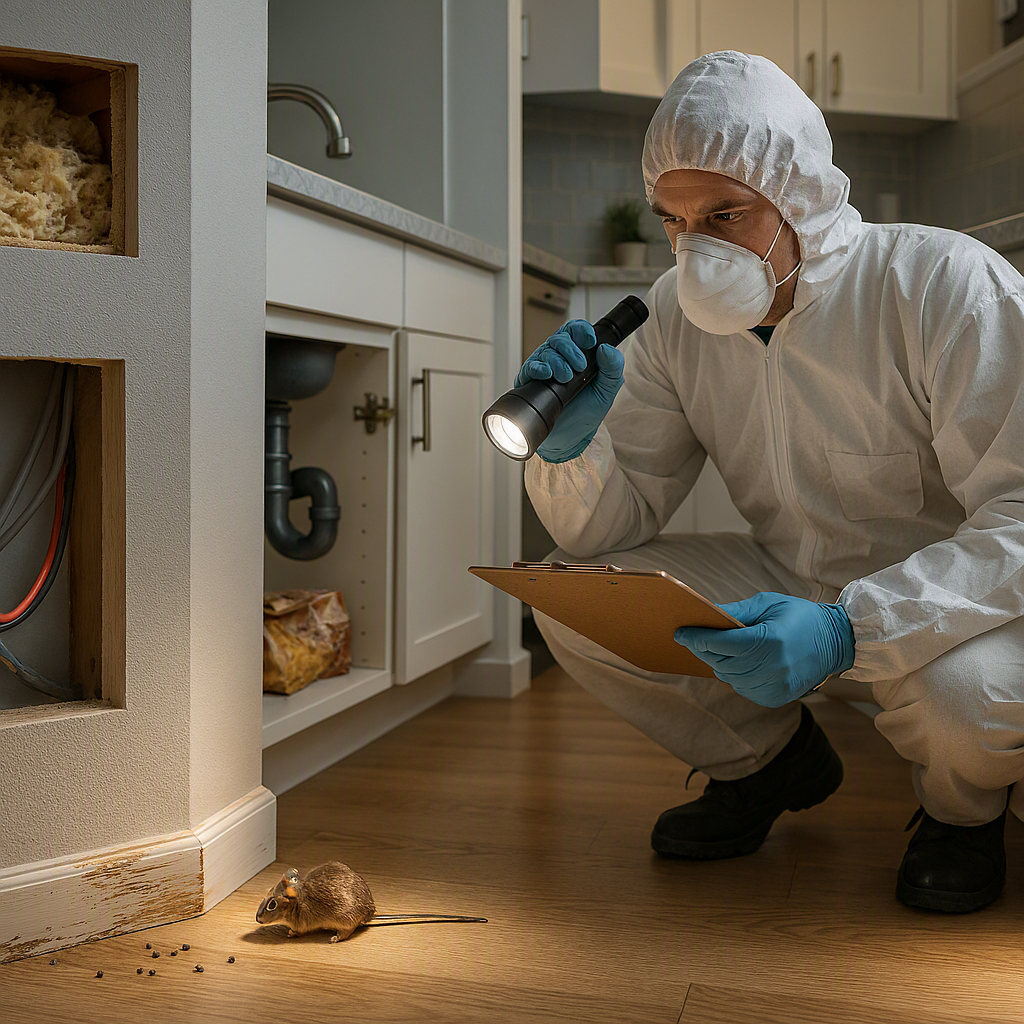
- Gather basic tools: a flashlight (a red-filtered lens disturbs foraging ants less), a flathead screwdriver or awl, and a moisture meter if you have one.
- Start in high-risk areas: bathrooms, kitchens, basements, attics, crawl spaces, and around window and door frames — anywhere moisture tends to collect.
- Look for frass and kick-out holes along baseboards, sills, and trim, especially near any past water damage.
- Tap suspect wood with a screwdriver handle and listen for a hollow sound.
- Probe the wood surface with the screwdriver tip — wood that a blade sinks into easily has likely been tunneled through.
- Check after dark, when carpenter ants are most active; listen for faint rustling inside walls and look for foraging trails.
- Watch for swarmers near windows and light sources, particularly in spring — this is one of the clearest indoor-nest indicators.
- Photograph and document anything you find, then contact a licensed pest control professional for confirmation before starting treatment, especially if you suspect the damage extends into structural framing.
Mistakes Homeowners Make
- Spraying visible ants with a repellent instead of finding the nest — this often causes colony budding rather than elimination.
- Mixing bait with sprays or dust in the same area. Ohio State University Extension notes that baiting should be a stand-alone strategy, since residual insecticides make ants avoid bait entirely.
- Treating only the symptom, not the moisture problem, which invites reinfestation even after a “successful” treatment.
- Assuming a few ants means a small problem. Foraging workers can travel a long way from the actual nest.
- Confusing carpenter ants with termites and buying the wrong product or service.
- Waiting to act after finding frass or swarmers, which gives an established colony more time to expand.
- Skipping the follow-up inspection after treatment, so a surviving satellite colony goes unnoticed.
Best Treatment Options Compared
| Method | Best For | Approx. Cost | Limitations |
|---|---|---|---|
| Boric acid / borate bait (DIY) | Small, recently found nests | $15–$50 | Requires locating active trails; slow-acting |
| Diatomaceous earth (DIY) | Cracks, voids, dry areas | $10–$30 | Loses effectiveness if it gets wet |
| Non-repellent perimeter spray (pro) | General structural protection | Included in $250–$500 service | Best combined with nest location, not alone |
| Insecticidal dust in wall voids (pro) | Confirmed indoor satellite nests | Included in pro service | Requires drilling access points |
| Bait stations (pro or DIY) | Colony elimination at the source | $20–$100+ (DIY) / included (pro) | Slower than contact sprays, but far more effective long-term |
| Full professional program with follow-up | Established or structural infestations | $500–$1,000+ | Higher upfront cost, but addresses satellite colonies |
Carpenter Ant Maintenance Checklist
- Inspect attic, crawl space, and basement twice a year
- Check gutters and downspouts are clear and draining away from the foundation
- Look for water stains or soft wood near plumbing and rooflines
- Keep firewood stacked away from the house and off the ground
- Trim back branches and vines touching the roof or siding
- Reseal or caulk visible gaps around pipes and cables annually
- Watch for frass or swarmers each spring
- Schedule a professional pest inspection if your home has a history of moisture issues
When to Call a Professional
DIY steps are reasonable for a small, freshly spotted, outdoor-adjacent problem. It’s time to call a licensed pest control professional when:
- You find winged swarmers indoors
- You hear rustling sounds inside walls or ceilings
- Wood sounds hollow or a screwdriver sinks into it easily
- You’ve already tried bait or dust and still see activity after several weeks
- You suspect the nest is inside a wall void, ceiling, or structural beam you can’t safely access
- You’re not fully sure whether you’re dealing with carpenter ants or termites
A professional inspection is also the safest way to confirm how far any existing damage has spread before you spend money on repairs.
Frequently Asked Questions
1. Do carpenter ants actually eat wood? No. Unlike termites, carpenter ants excavate wood to create nesting galleries but don’t digest it. The removed wood is pushed out of the nest as frass.
2. How can I tell carpenter ant damage from termite damage? Carpenter ant galleries are smooth and clean, cut mostly across the wood grain, with frass piles nearby. Termite damage follows the grain, often includes mud-packed tunnels, and has no frass. See the comparison table above for more distinctions.
3. How much does it cost to get rid of carpenter ants? Most professional treatments run $250–$500, though severe or hard-to-reach infestations can run higher. DIY materials are cheaper upfront but less reliable for locating every satellite colony.
4. Can carpenter ants cause a house to collapse? It’s extremely rare and would require years of undetected, extensive damage to a load-bearing member. It’s far more common for carpenter ants to cause costly localized repairs — sagging trim, weakened sills, or damaged framing — than a full structural failure.
5. Are carpenter ant bites dangerous? Generally not. Bites can cause a brief pinch and burning sensation from formic acid, but they aren’t venomous and aren’t known to transmit disease. Seek medical care if you notice signs of an allergic reaction.
6. How long does it take carpenter ants to damage a house? It varies widely with colony size and how much moisture is available, but meaningful structural damage typically develops over multiple years rather than weeks or months.
7. What attracts carpenter ants to a home? Moisture, above almost everything else. Leaky roofs and plumbing, poor drainage, clogged gutters, firewood against the house, and branches touching the roofline are the most common culprits.
8. Can I get rid of carpenter ants myself? For a small, recently discovered, outdoor-adjacent nest, DIY bait or dust products can work. For anything indoors, hidden, or already showing structural signs, a licensed professional is the safer and usually faster route.
9. Do carpenter ants come back after treatment? They can, especially if the original moisture problem was never fixed or if a satellite colony was missed. A follow-up inspection a few weeks after treatment is the best way to catch this early.
10. How do I know if I have a carpenter ant nest inside my house? Winged swarmers indoors, rustling sounds in walls at night, and frass piles near baseboards or window frames are the clearest indoor signs. If you notice any of these, an inspection is worth scheduling.
Conclusion
Carpenter ant damage rarely announces itself all at once. It shows up gradually — a small pile of frass here, a faint rustle in the wall there — which is exactly why so many infestations go unnoticed until the repair bill is bigger than it needed to be.
The good news is that carpenter ants are also one of the more preventable pest problems, precisely because they’re chasing something specific: damp or decaying wood. Fix the moisture, inspect regularly, and treat early signs seriously, and you dramatically reduce the odds of ever dealing with serious carpenter ant damage in the first place. When in doubt — especially with anything that sounds hollow or involves indoor swarmers — a licensed pest control inspection is a small cost against a much larger one.
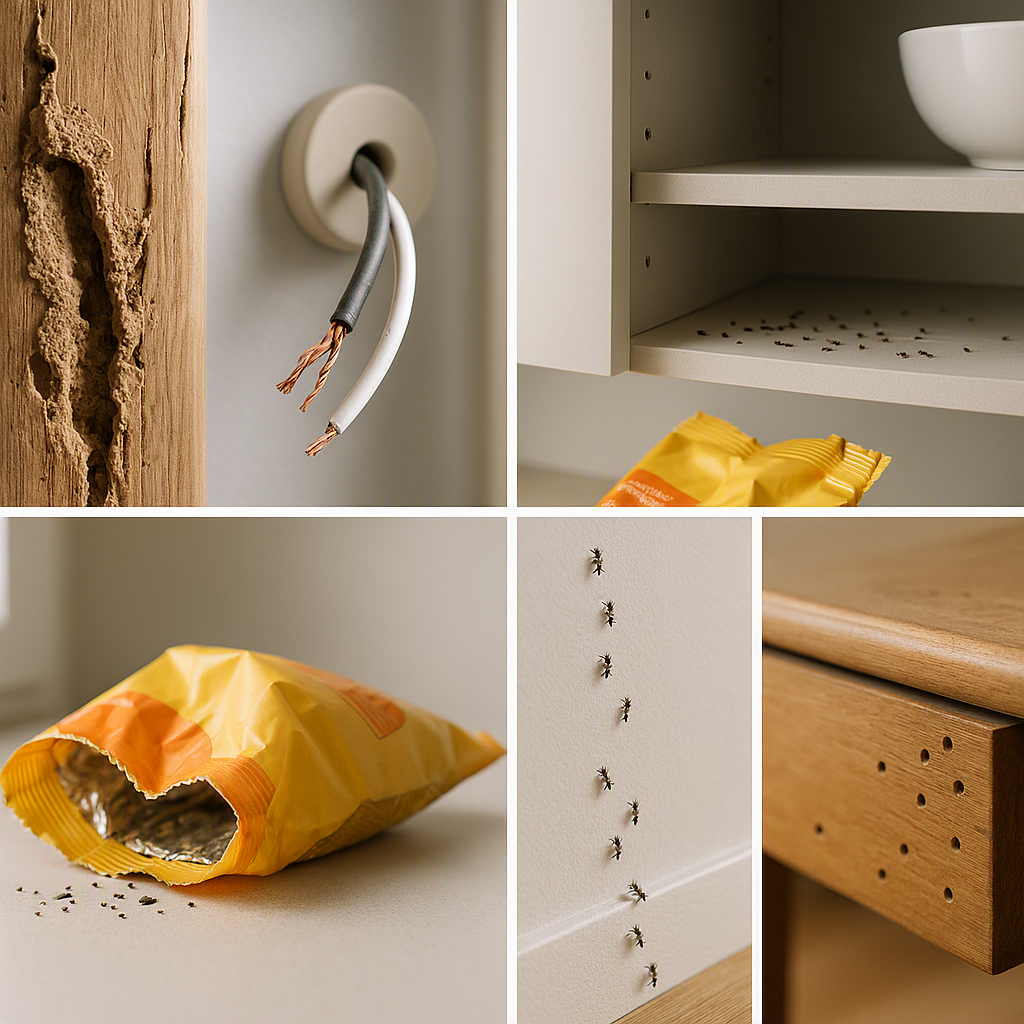
If you’re unsure whether the damage is caused by carpenter ants or termites, read our detailed guide on Termite Damage.
Wood-destroying insects aren’t the only threat to your home. Rodents can also cause serious structural problems. Learn more in our Rodent Damage Guide.
For homeowners dealing with wood damage, it’s also helpful to understand the warning signs of termite damage.Some homeowners mistake carpenter ants for rodents. Read our guide about rodent damage to compare the symptoms.Want to protect your home from every type of infestation? Browse all of our Pest Damage Guides.