Discovering a line of strange insects or mysterious wood damage can be unsettling for any property owner. Termites are among the most destructive pests in the world, causing billions of dollars in structural damage globally each year. Because they often eat wood from the inside out, an infestation can remain hidden for years before any obvious signs surface.
Accurate termite identification is the critical first step in protecting your home. Misidentifying a termite can result in delayed treatment, allowing these silent destroyers to compromise your property’s structural integrity. This comprehensive termite identification guide will help you confidently figure out what do termites look like, recognize early signs of termites, and determine your next steps.
What Are Termites?
Termites are social insects that belong to the order Blattodea (which also includes cockroaches). They live in highly organized colonies with a strict caste system where each member has a specific role to fulfill.
- Scientific Overview: Historically categorized under their own order (Isoptera), genetic testing has classified termites as specialized social cockroaches. Common species in North America fall under families like Rhinotermitidae and Kalotermitidae.
- Common Names: Termites, “silent destroyers,” white ants (a misleading common name, as they are not ants).
- Basic Characteristics: Termites are detritivores, meaning they feed on dead plant material and cellulose. Their unique gut microbes allow them to digest wood, paper, cardboard, and cotton.
Types of Termites
Not all termites are the same. Before you can identify termites, it helps to know which type you are dealing with, as their habitats and behavior vary greatly.
Subterranean Termites
Subterranean termites are the most widespread and destructive type. They live in underground colonies and require contact with soil to maintain moisture levels. To travel safely from the ground to the wood in your home, they construct distinct mud tubes.
Drywood Termites
Unlike their subterranean relatives, drywood termites do not need contact with the soil or extra moisture. They infest dry wood found above ground level, such as structural framing, hardwood floors, wooden furniture, and cabinetry.
Dampwood Termites
Dampwood termites are much larger than other types and target wood with very high moisture content. They are commonly found in rotting logs, stumps, or homes with severe plumbing leaks or wood-to-soil contact. They are rarely found in sound structural wood.
How to Identify Termites
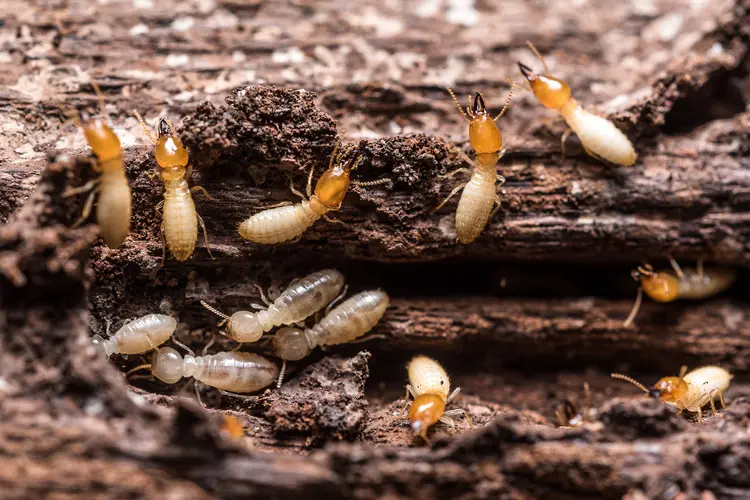
If you spot an insect and are wondering exactly what do termites look like, look closely for these specific physical characteristics:
- Size: Worker termites are small, typically measuring between 1/8 inch to 3/8 inch in length. King and queen termites can grow much larger, with the queen reaching over 1 inch when laying eggs.
- Shape: They have soft, pill-shaped, or cigar-shaped bodies that are uniform in width.
- Color: Workers are translucent, creamy-white, or pale yellow. Flying termites (reproductives) are much darker, ranging from dark brown to pitch black.
- Wings: Termite swarmers have two pairs of wings that are completely equal in size and shape. The wings are translucent, milky, and extend well past the end of the termite’s abdomen.
- Antennae: Their antennae are straight and resemble a string of tiny beads. They do not have elbows or bends.
- Waist: Termites have a broad, thick waist. Their thorax and abdomen are broadly joined without any constriction.
- Legs: They have six short, sturdy legs designed for crawling through tight tunnels rather than running across open floors.
- Distinctive Features: The soldiers have noticeably large, darkened heads equipped with powerful, scissor-like mandibles used to defend the colony.
Pictures to Include
When publishing this guide, insert clear, high-resolution images at these placeholders:
- [Image Placeholder: Worker Termite] – A close-up of a creamy-white worker chewing on a piece of cellulose.
- [Image Placeholder: Soldier Termite] – Showing the enlarged, rectangular orange head and prominent dark mandibles.
- [Image Placeholder: Flying Termite / Alate] – A dark-bodied reproductive termite displaying its four equal-length wings.
- [Image Placeholder: Close-up of Body] – A macro view highlighting the straight antennae and broad, thick waist.
- [Image Placeholder: Mud Tubes] – Mud tunnels running up a concrete foundation wall or joist.
- [Image Placeholder: Damaged Wood] – A cross-section of wood showing hollow galleries filled with soil or smoothly carved out.
- [Image Placeholder: Discarded Wings] – A pile of translucent wings left behind on a window sill or floor.
- [Image Placeholder: Termite Colony] – An exposed nest showing a mixture of workers, soldiers, and nymphs interacting.
Signs of a Termite Infestation
Because termites live deep inside walls or underground, you must look for indirect clues. The most reliable signs of termites include:
- Mud Tubes: Pencil-thick tunnels made of mud, soil, and saliva running along foundations, crawl spaces, or baseboards. These protect subterranean termites from dry air and predators.
- Hollow Wood: Tap your wooden structures with a screwdriver handle. If the wood sounds hollow, papery, or breaks easily away, termites may have gutted the interior.
- Frass: Drywood termites kick their waste out of tiny kick-out holes. This creates small piles of frass—pellets that look like mounds of coarse sand or ground pepper.
- Discarded Wings: After a swarm, flying termites shed their wings. Finding piles of identical translucent wings on windowsills, floors, or cobwebs is a major red flag.
- Damaged Furniture: Blistering or sagging veneer on wooden furniture, baseboards, or flooring can indicate active feeding underneath.
- Swarming Termites: Seeing hundreds of dark, winged insects flying indoors near light sources is a definitive sign of a mature, active colony nearby.
Where Are Termites Commonly Found?
Termites seek out dark, undisturbed locations with access to wood and moisture.
Indoors
Look inside walls, baseboards, window frames, door jambs, and wooden flooring. They also congregate in damp utility closets or behind bathroom drywall where slow leaks may hide.
Outdoors
Check old tree stumps, dead roots, firewood piles, wooden fence posts, and landscaping mulch that sits directly against the house.
Foundations and Crawl Spaces
This is the primary entry point for subterranean termites. Check concrete expansion joints, mudsills, floor joists, and support piers for mud tubes.
Seasonal Activity
Termite swarms typically occur during the spring and early summer. These events usually take place on warm, humid days immediately following a heavy rain, as the damp air protects the swarmers from drying out.
Geographic Distribution
Termites are found in almost every state in the U.S. (except Alaska), but they are heavily concentrated in the warm, humid regions of the South, Southeast, and West Coast.
Common Look-Alikes
The most frequent error homeowners make is confusing a flying termite with a flying ant. Use this termite vs flying ants reference table to tell them apart easily:
| Pest | Similarities | Differences | How to Identify Correctly |
| Flying Termite | Dark body, wings, swarms in spring around light. | Straight antennae, thick waist, 4 wings of perfectly equal length. | Look at the wings: if they are twice as long as the body and identical, it is a termite. |
| Flying Ant | Dark body, wings, swarms in spring or summer. | Elbowed antennae, pinched “wasp-like” waist, 2 long front wings and 2 short hind wings. | Look at the waist line: a distinct, narrow pinch means it is an ant. |
| Carpenter Ant | Chews into wood, leaves piles behind. | Does not eat wood; creates clean galleries and throws out coarse sawdust (frass mixed with insect parts). | Look for elbowed antennae and a pinched waist. They are also seen walking openly in daytime. |
| Powderpost Beetle | Attacks wood, leaves holes. | Adults are small beetles; larvae boring into the wood leave fine, flour-like powder. | Look for tiny, perfectly round exit holes (1/32 to 1/16 inch) rather than hollow galleries. |
Life Cycle
Termites undergo incomplete metamorphosis, moving through three main stages: egg, nymph, and adult.
[Egg] ──> [Nymph] ──> [Caste Differentiation: Worker, Soldier, or Alate]
- Egg: The queen lays tiny, white, kidney-shaped eggs that are tended to by workers deep within the nest.
- Nymph: Eggs hatch into pale nymphs. Through successive molts, pheromones from the king and queen dictate which caste the nymph will develop into.
- Worker: The backbone of the colony. These blind, wingless adults forage for food, maintain the nest, and feed the other castes.
- Soldier: Wingless defenders with large heads and mandibles. They cannot feed themselves and rely on workers for survival.
- Reproductive (Alate): The future kings and queens. They develop wings and dark pigment, waiting for the perfect weather conditions to swarm, mate, and start new colonies.
- Queen and King: The original founders of the colony. The queen’s body expands significantly to become an egg-laying machine, producing thousands of eggs daily.
- Lifespan: Workers and soldiers live for 1 to 2 years. Queens are incredibly resilient and can live for decades under optimal conditions.
Are Termites Dangerous?
Understanding the actual risks of a termite infestation helps you prioritize your pest control strategy.
- Property Damage: Termites pose a severe threat to your finances. Because they compromise structural framing, roof supports, and subfloors, an unchecked infestation can lead to catastrophic structural failure.
- Human Health: Termites do not bite or sting humans, and they do not spread diseases. However, their presence in walls can cause extensive mold growth due to the moisture they introduce, which can aggravate allergies and respiratory issues.
- Pets: They do not pose a direct threat to dogs, cats, or other household pets.
- Structural Risks: Termite damage can render a home uninsurable and drastically decrease its resale value. Standard homeowners insurance policies rarely cover termite damage, making prevention and early detection vital.
What Attracts Termites?
You can significantly lower your risk of an infestation by eliminating the things that attract termites to your property:
- Wood-to-Soil Contact: Door frames, deck posts, or wood siding touching the ground give termites a direct, hidden highway into your home.
- Excess Moisture: Standing water near foundations, leaking gutters, broken downspouts, and poor crawl space ventilation create an ideal habitat.
- Landscaping Mulch: Thick layers of wood mulch hold moisture and provide both food and cover right next to your foundation.
- Firewood Stacks: Storing firewood or scrap lumber directly against your house offers an easy staging ground for a colony.
How to Confirm Identification
Before you call a professional, you can conduct a quick, practical inspection around your property:
- The Flashlight and Screwdriver Test: Take a bright flashlight into your basement or crawl space. Inspect the sill plate and floor joists. Firmly press the tip of a flathead screwdriver against the wood. If it sinks into the wood easily or the wood splinters open effortlessly, inspect the interior cavity for mud or insects.
- Examine Windowsills: Look for piles of dropped wings or small, sand-like pellets on interior and exterior windowsills.
- Inspect the Foundation: Walk around the exterior perimeter of your home. Look closely at the concrete foundation just above the soil line for any evidence of mud tubes.
- Collect a Specimen: If you find a dead or live insect, trap it in a small container or a piece of clear tape. Keeping the specimen intact makes it easy to verify using a magnifying glass or to show an expert.
What to Do Next
A DIY inspection is excellent for early detection, but dealing with an active termite infestation is rarely a DIY job.
When DIY Is Appropriate
If your inspection reveals no active termites, you can take preventative DIY steps. Install physical barriers, fix moisture issues, replace wood mulch with rubber or gravel alternatives, and apply over-the-counter liquid barriers or bait stations around the perimeter to keep them away.
When to Call a Professional
If you find active mud tubes, hollow structural wood, or see a live termite swarm inside your living space, it is time to contact a licensed pest control professional immediately. Termite colonies can number in the hundreds of thousands and extend deep underground. Professionals have specialized tools, such as thermal imaging cameras, soil injection rods, and industrial-grade termiticides or bait systems required to completely eliminate the colony.
Frequently Asked Questions
Can you see termites with the naked eye?
Yes. While workers spend their lives hidden inside wood or soil, you can easily see them if you break open an active piece of wood. Flying termites and soldiers are also clearly visible without magnification.
What do termites look like to the human eye?
To the naked eye, worker termites look like small, slow-moving, creamy-white or translucent ants without a pinched waist. Flying termites look like small, black ants with long, overlapping silver-white wings.
Do termites fly into houses?
Yes. During swarming season, flying termites may enter through open windows, doors, or cracks in the foundation. If you see them swarming inside your home, it usually indicates that a mature colony is already nesting within the structure.
How do I know if I have ants or termites?
Look at the waist and antennae. Ants have a distinct, narrow, pinched waist and bent (elbowed) antennae. Termites have a thick, straight waist and straight, bead-like antennae.
Do termites make a sound?
Yes, but it is very quiet. Soldier termites bang their heads against tunnel walls to warn the colony of danger. If you press your ear against an infested wall in a quiet room, you might hear a faint clicking or rustling sound.
Can termites eat through concrete?
No, termites cannot eat or chew through concrete. However, they can squeeze through incredibly small hairline cracks within a concrete foundation—some as thin as 1/32 of an inch.
How fast can termites destroy a home?
It takes time. A mature colony of subterranean termites can eat through a 2×4 piece of wood in a few months. While they will not destroy a home overnight, an unnoticed infestation can cause severe structural damage within 1 to 2 years.
What color are termites?
Termites vary in color by caste. Workers are translucent or creamy-white, soldiers have white bodies with yellowish-brown heads, and reproductive swarmers are dark brown or solid black.
Key Takeaways
- Check the Shape: Termites have a thick, uniform waist and straight, bead-like antennae. They never have the pinched waist or bent antennae of an ant.
- Watch for Wings: Flying termites have four wings of equal length that are twice as long as their body.
- Look for the Tubes: Mud tubes running up your foundation walls are a definitive sign of subterranean termites.
- Inspect the Wood: Sound wood that sounds hollow when tapped or yields easily to a screwdriver requires immediate professional evaluation.
Suggested Internal Linking Opportunities
- Link to your comprehensive guide on: How to Get Rid of Subterranean Termites (Context: “Subterranean termites are the most widespread…”)
- Link to an article about: The Best Termite Bait Stations for Homeowners (Context: “…apply over-the-counter liquid barriers or bait stations…”)
- Link to a guide on: How to Identify and Treat Water Damage in Crawl Spaces (Context: “…excess moisture, leaking gutters, and poor crawl space ventilation…”)
- Link to a diagnostic post: What Kind of Ants Are in My House? (Context: “…confusing a flying termite with a flying ant…”)
- Link to a resource covering: Does Homeowners Insurance Cover Termite Damage? (Context: “Standard homeowners insurance policies rarely cover…”)
External Authoritative References
- United States Environmental Protection Agency (EPA): Termites: How to Identify and Control Them
- University of California Agriculture and Natural Resources (UC IPM): Termites Management Guidelines
- University of Florida Extension (EDIS): How to Identify Termite Alates
- Texas A&M AgriLife Extension: Subterranean Termite Identification and Control
- Iowa State University Extension: Small Insects in Wood – Termite Identification